Why PratMOS
A name with a meaning, a way of working with a check at every stage, and one VLSI team from floorplan to signoff.

The name
A name that does two jobs
Pratam (प्रथम) is Sanskrit for first: first in rank, first in line. It's the bar we set for ourselves, to be the team a design lead calls first when timing won't close or the IR report looks wrong.
MOS is metal-oxide-semiconductor, the three-layer sandwich inside every transistor from planar MOSFETs to FinFETs and nanosheet GAA. Everything we sign off is built on it, so it belongs in the name.
Put together: pinnacle MOS engineering, from architecture to tapeout.
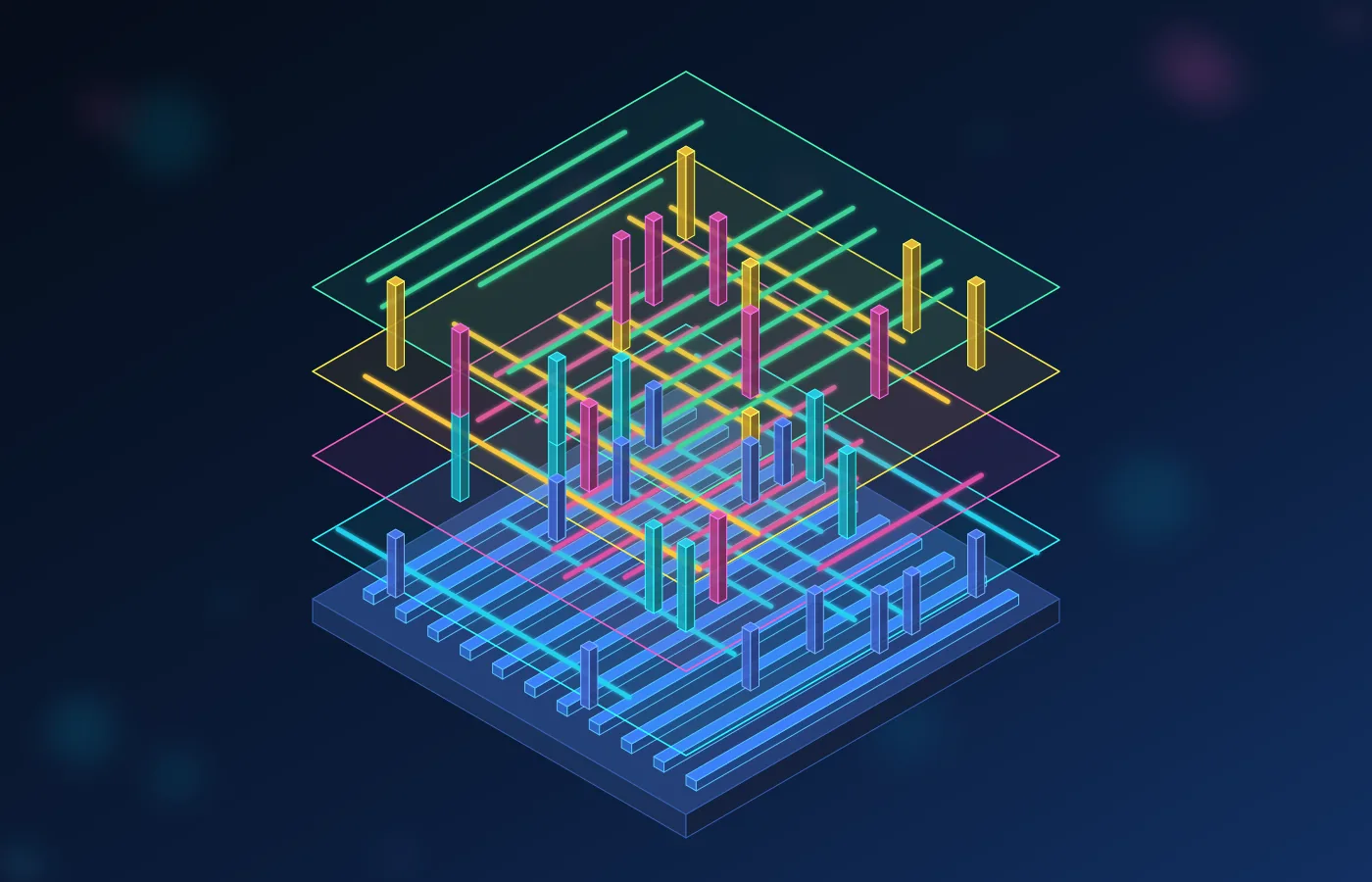
One team, every layer
Timing, power and manufacturing share one layout
A chip is a stack: transistors at the bottom, then metal layer on metal layer above, joined by vias. A change on one layer shows up in every check. Widening a clock net helps timing and hurts congestion. Upsizing a cell fixes a path and raises IR drop next door.
That is why physical design, STA, EM / IR and physical verification sit on one team at PratMOS. The person who makes the change sees all four reports, so the fix does not quietly break something else.
See the six skillsHow we work
What this means for your project
Six habits that show up in every tapeout we touch.
One team, floorplan to signoff
Physical design, timing signoff, power integrity and physical verification sit together, so a timing fix that hurts IR is caught by the people who made the change.
Power and macros first
We plan macro placement and the power grid at the start, because that is where late-stage surprises come from.
Gates, not surprises
Every stage ends at a gate. A red gate gets fixed on the spot instead of being carried into the next stage.
Signoff-quality tools and corners
Every check is run in industry-standard signoff tools, across every corner and mode your PDK defines, not just the ones that are easy to close.
Reports you can read
Each gate produces a short, plain report: what was checked, what failed, what we changed and what is left. No surprises in the final week.
Reusable handover
You receive the database, reports and rerunnable scripts, so your team can reproduce the result and carry on after we finish.
Tapeout pipeline
How a tapeout moves through us
Four stages, and each one ends at a gate. If the gate isn't green, we fix it there instead of carrying the problem forward.
Floorplan and power
Macro placement, pin assignment, power grid planning and the IO / ESD ring.
GateMacros legal, pins reachableGrid inside IR budgetFusion Compiler · IC Compiler II · Innovus · RedHawk-SC · VoltusPlacement and CTS
Congestion-driven placement, multi-corner clock trees and skew work.
GateCongestion under controlSkew and latency on targetFusion Compiler · IC Compiler II · Innovus · PrimeTime · TempusRouting and ECO
Detailed routing, crosstalk avoidance, timing ECOs and hold fixing.
GateNo open or short netsSetup and hold cleanIC Compiler II · Innovus · StarRC · QuantusGDSII signoff
DRC / LVS, final MCMM timing, dynamic IR check and stream-out.
GateDRC / LVS cleanWNS at or above zero, all cornersPrimeTime · Tempus · Calibre · IC Validator · Pegasus
A red gate means we stop and fix it right there. That's cheaper than finding it at stage four.
Engagement
Three ways to work with us
Take the whole flow, or only the piece that is stuck.
Turnkey closure
Netlist or RTL in, signed-off GDSII out. One team owns floorplan, implementation, timing, power integrity and physical verification.
Signoff only
You implement, we sign off: STA, EM / IR, DRC / LVS and ECO guidance on a database you hand over.
Single-stage support
One piece is stuck: DFT, design verification, physical verification, or a timing or IR closure sprint.
Handover
What you receive at the end
Signoff is only useful if your team can read it and rerun it. Every project ends with the same set of artefacts, whatever the node.
- Final GDSII or OASIS, netlist, SDC and SPEF
- Timing reports for every corner and mode
- IR and EM reports with hot-spot maps
- DRC, LVS, ERC and antenna logs with waiver notes
- Rerunnable flow scripts with a short README
- Signoff checklist showing the result of every gate
gate summaryillustrative
GATE 1  floorplan + power     PASS
GATE 2  placement + CTS       PASS
GATE 3  routing + ECO         PASS
GATE 4  GDSII signoff
  timing  all corners        WNS >= 0
  IR / EM static + dynamic   PASS
  DRC / LVS / antenna        CLEAN
ready for stream-out
Want to see how that applies to your design?
Send us the node, the schedule and the stage you are at.